
We may earn revenue from the products available on this page and participate in affiliate programs. Learn More ›
Whether you’re repairing a roof, redoing wood floors, or starting any other type of major do-it-yourself project, chances are you’ll want a nail gun (also called a nailer). This handy power tool drives nails and other small fasteners deep into the wood’s surface without splintering or harming the wood’s structural integrity.
We wanted to see which of today’s most popular nail guns would speed up our projects and drive nails accurately, so we decided to put them to the test. We tested a range of nail guns, including finish nailers, framing nailers, roofing nailers, siding nailers, and brad nailers. All of the picks featured in this lineup were top performers for various fastening tasks, but the DeWalt angled finish nail gun took top honors for power, precision, and an angled nail rail that makes it well suited for tight spots.
Today’s nailers are tailored to specific tasks, and choosing the correct type for a project is essential. Below, we provide the info on finding the best nail gun for your next project, plus full details on how the following models earned a spot in our hands-on tests.
- BEST OVERALL: DeWalt 20V MAX 16 GA Angled Finish Nailer Kit
↓ Jump to Review - RUNNER UP: Metabo HPT MultiVolt 16-Gauge 2½-in Finish Nailer
↓ Jump to Review - BEST BANG FOR THE BUCK: Ryobi ONE+ HP 18V 16-Gauge Finish Nailer
↓ Jump to Review - BEST BRAD NAILER: Bostitch Smart Point 18 GA Brad Nailer Kit and Nails
↓ Jump to Review - BEST CORDLESS BRAD: Ryobi ONE+ 18V Cordless AirStrike Brad Nailer
↓ Jump to Review - BEST FLOORING NAILER: Bostitch 2-in-1 Flooring Tool
↓ Jump to Review - BEST UPGRADE: Milwaukee M18 FUEL 16-Gauge Angled Finish Nailer
↓ Jump to Review - BEST SIDING NAILER: Bostitch N66C-1 1¼-to-2½-Inch Coil Siding Nailer
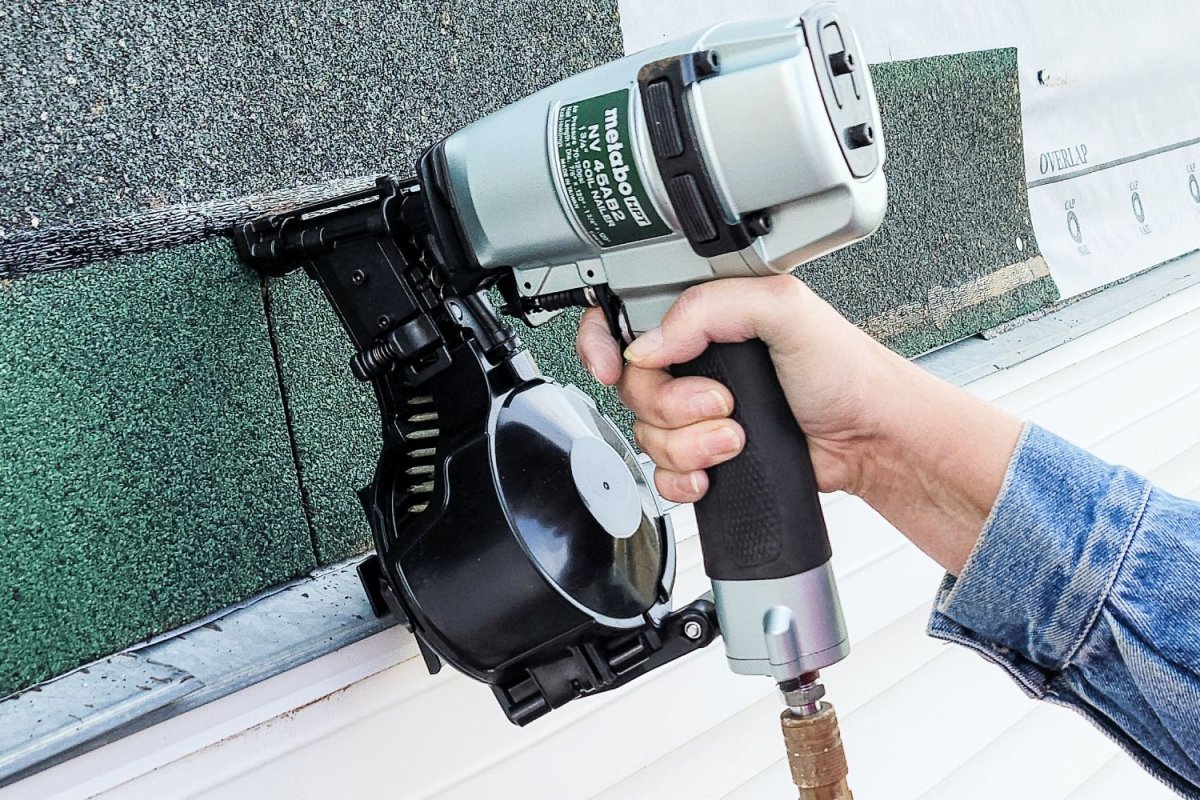
↓ Jump to Review - BEST ROOFING NAILER: Metabo HPT 1¾-Inch Coil Roofing Nailer
↓ Jump to Review - BEST FRAMING NAILER: Milwaukee M18 FUEL 21-Degree Framing Nailer Kit
↓ Jump to Review
Best Nail Guns Compared
| Product | Nail sizes | Power | Weight | Our Rating |
| DeWalt 20V MAX 16 GA Angled Finish Nailer Kit | 16 gauge; 1¼ to 2½ inches long | Battery | 10 pounds | 4.6/5 |
| Metabo HPT MultiVolt 16-Gauge 2½-in Finish Nailer | 16 gauge; 1 to 2½ inches long | Battery | 5.7 pounds | 4.5/5 |
| Ryobi ONE+ HP 18V 16-Gauge Finish Nailer | 16 gauge; 1¼ to 2½ inches long | Battery | 5.7 pounds | 4.3/5 |
| Bostitch Smart Point 18 GA Brad Nailer Kit and Nails | 18 gauge; ⅝ to 2⅛ inches long | Pneumatic | 3 pounds | 4.5/5 |
| Ryobi ONE+ 18V Cordless AirStrike Brad Nailer | 18 gauge; ⅝ to 2⅛ inches long | Battery | 5.4 pounds | 4.4/5 |
| Bostitch 2-in-1 Flooring Tool | 15½-gauge flooring staples or 16-gauge cleats; 1½ to 2 inches long | Pneumatic | 14.7 pounds | 4.7/5 |
| Milwaukee M18 FUEL 16-Gauge Angled Finish Nailer | 16 gauge; 1¼ to 2½ inches long | Battery | 6.5 pounds | 4.8/5 |
| Bostitch N66C-1 1¼-to-2½-Inch Coil Siding Nailer | 1¼ to 2¼ inches long | Pneumatic | 5.1 pounds | 4.5/5 |
| Metabo HPT 1¾-Inch Coil Roofing Nailer | 11 gauge; ⅞ to 1¾ inches long | Pneumatic | 5.7 pounds | 4.7/5 |
| Milwaukee M18 FUEL 21-Degree Framing Nailer Kit | 9 to 12 gauge, 2 to 3½ inches long | Battery | 11 pounds | 4.7/5 |
Our Top Picks
We tested a whole lot of nail guns, and the ones in this lineup represent the best models on the market today. The following nailers vary by type; some are designed for building structures, while others are made for installing trim or shingles, or attaching siding to a house. Each one excelled in our hands-on tests, and we feel confident in their performance and power.
Best Overall

DeWalt 20V MAX 16 GA Angled Finish Nailer Kit
Photo: Ace Hardware
What We Like
- Adjustable depth ensures accuracy on different woods
- Angled nail rail for better maneuverability
- Single-fire or bump mode for versatility
- Quick-clear jam release
What We Don’t Like
- A pricey option
Product Specs
-
Nail size:
16 gauge; 1¼ to 2½ inches long -
Power source:
Battery -
Weight:
10 pounds
Our Ratings
| Ease of Use | 4.8/5 | Ergonomics | 4/5 | Performance | 4.8/5 | Durability | 4.5/5 | Value | 4.5/5 |
We didn’t set out to choose a finish nailer as our best pick, but the 16-gauge DeWalt angled finish nailer excelled in several areas. It’s not suitable for framing or installing shingles, but we felt it offered the best overall combination of features, power, and versatility.
DeWalt is a reputable manufacturer of both DIY and pro tools, so we were expecting this model to be a top performer, and it didn’t disappoint. After fully charging the battery, we loaded a strip of 20-degree, 2½-inch, 16-gauge nails into the rail. We shot nails into oak, walnut, and pine boards, and using the depth-adjustment feature, we adjusted the nailhead depth to suit the hardness/softness of each wood.
This finish nailer shot the nails flawlessly, even when we switched to bump mode and ran through the clip at a rapid pace. We then loaded a strip of 1¼-inch nails and continued testing. It shot the shorter nails just as smoothly as the longer ones. In all, we shot over 250 nails, and the gun never jammed. That’s pretty impressive since some nail guns jam frequently when shooting in bump mode.
What our tester says: “I found the DeWalt angled finish nailer easy to use and comfortable to hold with its rubberized grip and ergonomic shape. If you’re looking for a powerful nail gun for baseboards, casing, stair risers, or for any other project where finish nails are called for, this might be your pick.”—Glenda Taylor, Product Reviews tester and writer
Get the DeWalt angled finish nail gun at Amazon, Ace Hardware, or The Home Depot.
Runner-Up
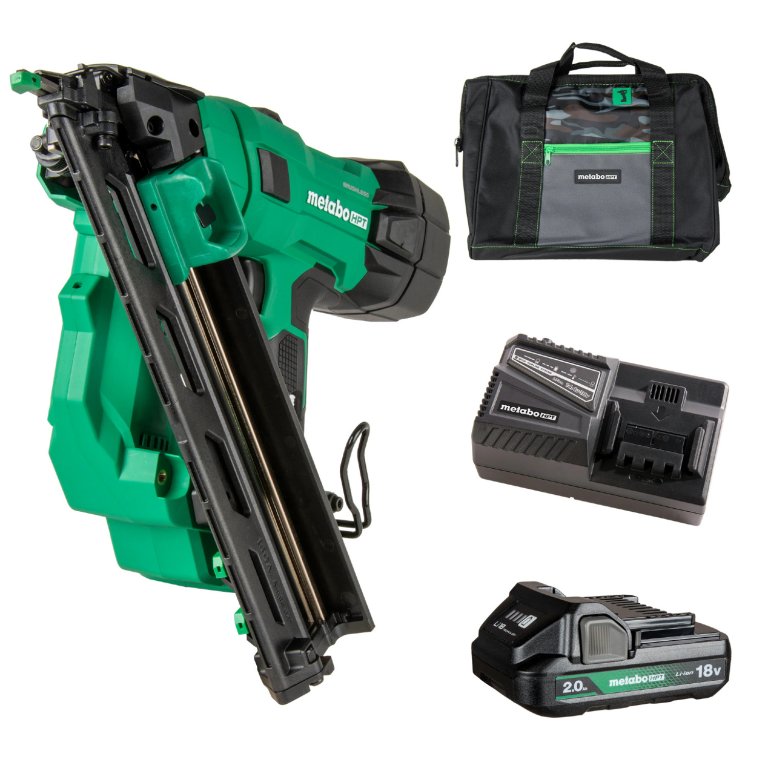
Metabo HPT MultiVolt 16-Gauge 2½-in Finish Nailer
Photo: Lowe’s
What We Like
- Lightweight design with streamlined head
- Plenty of power for driving nails
- Easy-to-use controls
What We Don’t Like
- Significant tearout on softer woods
Product Specs
-
Nail size:
16 gauge; 1 to 2½ inches long -
Power source:
Battery -
Weight:
5.7 pounds
Our Ratings
| Ease of Use | 4.6/5 | Ergonomics | 5/5 | Performance | 4.3/5 | Durability | 4.5/5 | Value | 4.3/5 |
Metabo’s nailers are well regarded for their power and streamlined design, and this cordless 16-gauge finish nailer is a great example of that. At about 6.5 pounds with its 2Ah battery, it’s one of the lighter cordless nailers we’ve tested. It also has a narrow head that allows for a better sight line and hence more accurate firing. Its compact size makes it easier to fit in tighter spots, too, such as inside a cabinet.
The Metabo packs plenty of nail-driving power. We started by firing more than 50 nails into soft pine and found ourselves having to dial back the depth to avoid overdriving them. We then moved to hardwood birch plywood. After a few turns of the dial, the Metabo had little trouble burying other nails into the wood.
In addition to power, the Metabo also has speed. It fires with no delay when pulling the trigger, largely thanks to its air spring drive system, which helps provide rapid bump firing. It’s also reliable—over the course of firing some 100 nails, we didn’t experience any jams.
Where the Metabo did concern us was with its collateral damage to wood. It produced more tearout than any other finish nailer we tested. That means more work filling nail holes after installing trim or baseboards.
Get the Metabo HPT MultiVolt 16-Gauge nailer at Lowe’s.
Best Bang For The Buck
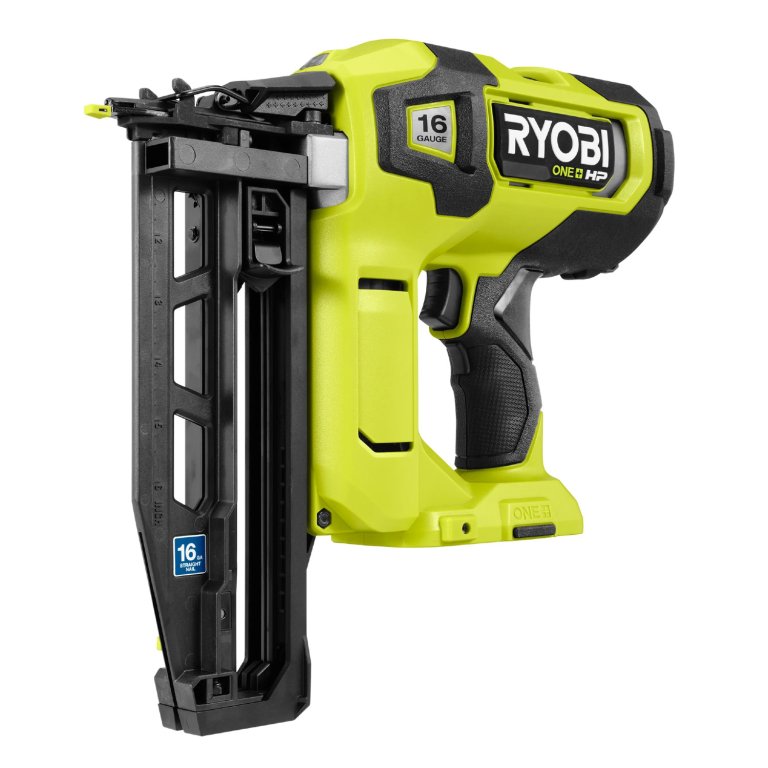
Ryobi ONE+ HP 18V 16-Gauge Finish Nailer
Photo: The Home Depot
What We Like
- Excellent nail driving power
- Dry lockout feature
- Resist jamming
What We Don’t Like
- Head is a little bulky
Product Specs
-
Nail size:
16 gauge; 1¼ to 2½ inches long -
Power source:
Battery -
Weight:
5.7 pounds
Our Ratings
| Ease of Use | 4.5/5 | Ergonomics | 4/5 | Performance | 4.3/5 | Durability | 4/5 | Value | 4.5/5 |
Ryobi has long catered to DIYers with its reasonably priced line of cordless power tools. In recent years, Ryobi has been gaining on the premium brands when it comes to performance, and that’s exactly what we found with its 18-volt brushless cordless 16-gauge nailer.
The PBL370 was impressive during testing, driving nails deep into an oak board. We even had to dial the power all the way back on the tool’s depth adjuster just to avoid overdriving 2-inch nails into softer wood. We pushed this tool hard, switching it to bump fire mode and tapping out more than 100 nails. While it was slower than some higher-end nailers, we were still able to drive about two nails per second. We also didn’t record a single instance of jamming despite our best efforts.
While we loved the performance of this nailer, we did have some minor complaints. The PBL370 does have a slightly longer delay between when you press the trigger and when it fires. At just under 7 pounds with its recommended 4Ah battery, the Ryobi 16-gauge nailer is on the lighter end of finish nailers. However, the head is a little bulkier than what you’d find on those professional-grade nailers, which made it more difficult to line up shots accurately.
Get the Ryobi 16-gauge straight finish nailer at The Home Depot.
Best Brad Nailer
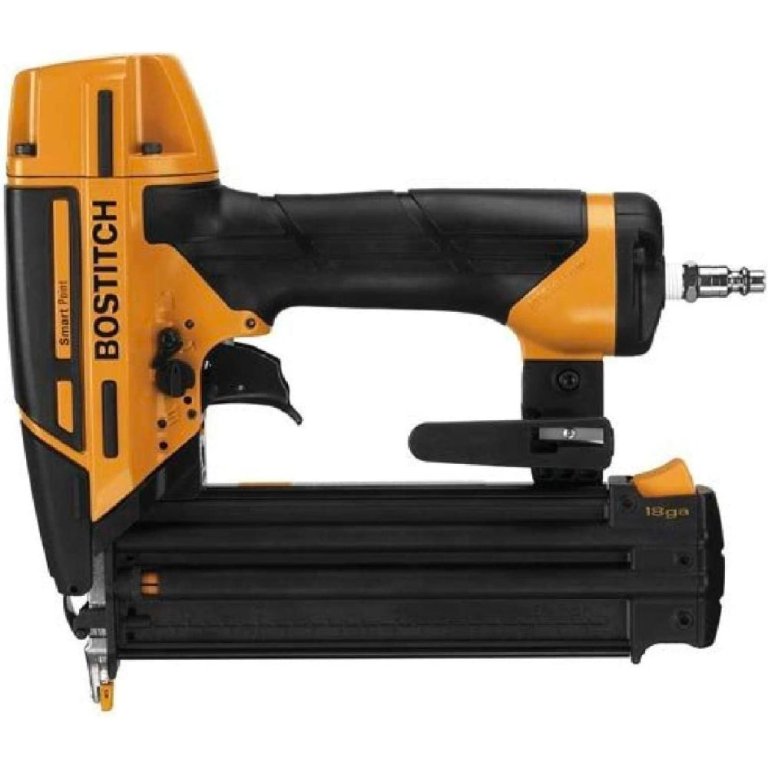
Bostitch Smart Point 18 GA Brad Nailer Kit and Nails
Photo: Amazon
What We Like
- Good nail-depth adjustment adapts to various wood densities
- Powerful nail deployment ensures nailheads don’t stick up
- Pointed tip assists in precise nail placement
What We Don’t Like
- Doesn’t come with angled nail rail
Product Specs
-
Nail size:
18 gauge; ⅝ to 2⅛ inches long -
Power source:
Pneumatic -
Weight:
3 pounds
Our Ratings
| Ease of Use | 4.5/5 | Ergonomics | 5/5 | Performance | 4.3/5 | Durability | 4/5 | Value | 4.7/5 |
We’ve long admired Bostitch’s nailers (as well as its staple guns), and this powerful little brad nailer was no exception. We connected it to our compressor via a hose; inserted a strip of 18-gauge 2-inch nails; and tested the gun on oak, walnut, and pine boards. It has an easy-dial depth adjustment we used when we switched between different wood hardnesses, and we were able to shoot brads consistently with the heads just slightly countersunk, which is what we were hoping to do.
We shot more than 200 brads, switching back and forth between 2- and 1-inch lengths. The Bostitch didn’t jam in all that time, but if it had, we would have removed the jammed nail via its handy quick-clear jam release.
The Bostitch brad nailer doesn’t come with an angled nail rail, which would have been handy when we were shooting nails in tight spots, but it’s highly reliable, and it even comes with a bump (multifire) mode. Realistically, you rarely need bump mode on a brad nailer since this type of nail gun is used mainly for installing trim, a precise task that doesn’t lend itself to rapid firing.
Get the Bostitch Smart Point nail gun at Amazon, Lowe’s, or Ace Hardware.
Best Cordless Nailer

Ryobi ONE+ 18V Cordless AirStrike Brad Nailer
Photo: The Home Depot
What We Like
- Nail-depth adjustment enables trimming in different wood densities
- Single-fire and bump modes make tool very adaptable
- Powerful nail deployment for accurately seated nailheads
What We Don’t Like
- Unangled nail rail tough fit in tight spaces
Product Specs
-
Nail sizes:
18 gauge; ⅝ to 2⅛ inches long -
Power:
Battery -
Weight:
5.4 pounds
Our Ratings
| Ease of Use | 4.4/5 | Ergonomics | 4.5/5 | Performance | 4.3/5 | Durability | 4.5/5 | Value | 4.7/5 |
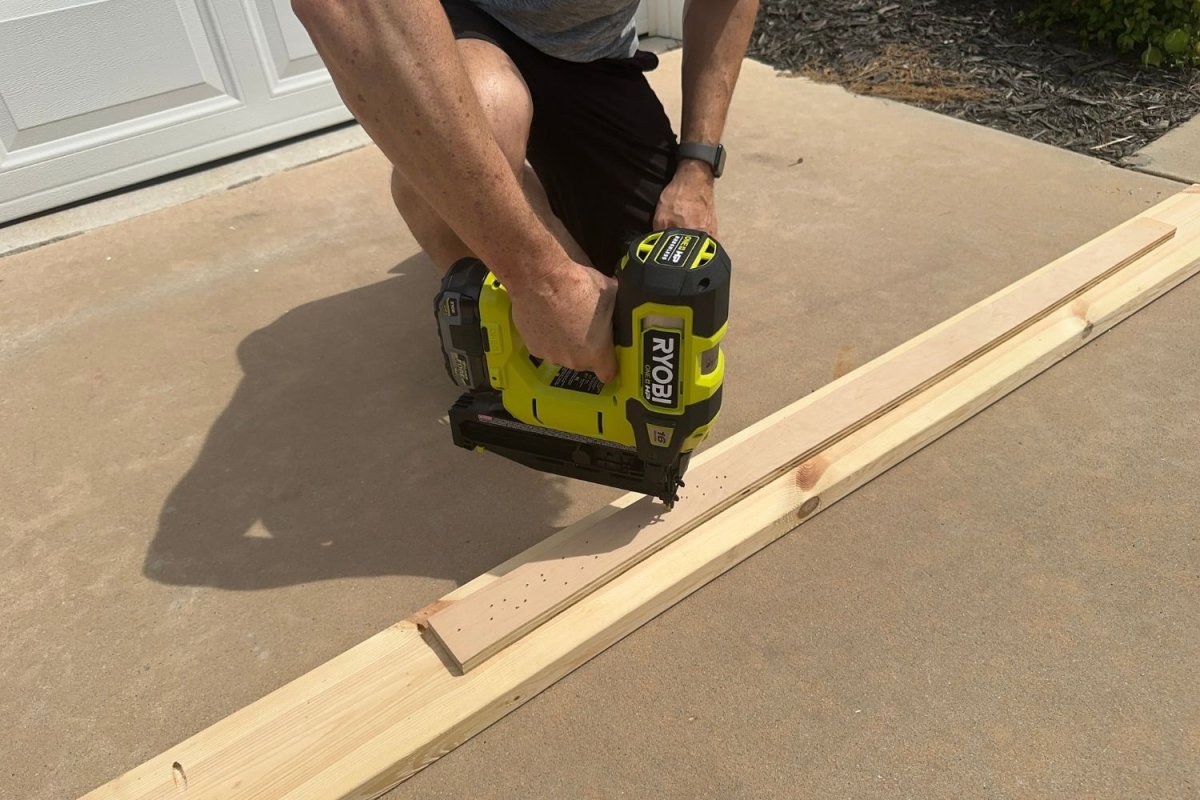
The Ryobi ONE+ cordless brad nailer comes with a tip that helped us insert the nails exactly where we wanted them. While high precision isn’t always necessary with framing nailers, installing delicate trim work requires exact fastener placement, and this nail gun shines in that regard. We liked the fact that it was cordless; many brad nailers are still pneumatic, and an air hose can get in the way at times.
We charged the battery, loaded a strip of 18-gauge 1-inch brad nails, and started our testing by shooting them into oak and walnut boards. At first, the nailheads were sitting a little too high, but we adjusted the nail depth until they were just below the surface of the wood. We shot over 100 brads before switching to pine boards, where we had to lessen the nail depth to suit the softer wood.
We had three nail jams with the 1-inch nails, but the quick-clear jam release made them easy to clear. We also tested the Ryobi by loading 1½-inch brads, and we didn’t get any jams with those. In addition to the precision tip, this brad nailer also comes with a bright LED guide light, which we found helpful in low-light situations. It comes with a bump mode, which isn’t often used in precision trim installation. We would have preferred an angled nail rail instead, which would have made it easier to use the tool in tight spots.
Get the Ryobi AirStrike nail gun at The Home Depot.
Best Flooring Nailer

Bostitch 2-in-1 Flooring Tool
Photo: Amazon
What We Like
- Fires cleats at precise angle; no guesswork
- Nails while locking flooring strips together
- Soft-grip handle reduces fatigue during long installs
- Accurate cleat insertion for professional-looking results
What We Don’t Like
- No quick-clear jam release
Product Specs
-
Nail size:
15½-gauge flooring staples or 16-gauge cleats; 1½ to 2 inches long -
Power source:
Pneumatic -
Weight:
14.7 pounds
Our Ratings
| Ease of Use | 4.7/5 | Ergonomics | 4.5/5 | Performance | 4.8/5 | Durability | 4.5/5 | Value | 4.7/5 |
The Bostitch 2-in-1 Flooring Tool works on a slightly different principle than the other nailers we tested, and not only did it save a lot of time as a result, but it also ensured that the hardwood strips were seated tightly against one another.
We tested it on an actual hardwood floor installation, and we liked it so much that we completed the whole floor with it. It sure beats the manual way of nailing each flooring strip by hand. We loaded the flooring nail gun with 2-inch-long 16-gauge nail cleats, which are nails with a tiny bend at the top rather than a traditional nailhead. It also accommodates 15½-gauge flooring staples.
After connecting the flooring nailer to the air compressor via a hose, we started nailing the strips. We positioned the Bostitch flooring nailer against the edge of the hardwood strip we wanted to attach. Rather than a trigger, this nailer features a mallet actuator, a knob that causes the nailer to fire a cleat when hit with the included mallet. It didn’t take a hard hit to get the nailer to fire—more of a firm tap.
Installing hardwood requires inserting a nail through the tongue side of a tongue-and-groove strip at an angle that goes through the tongue and into the subflooring. With the Bostitch, there was no guessing—the nailer shot each nail at just the right angle. In addition, when we hit the mallet actuator, the force of the nail firing helped secure the strip we were installing against the previous strip. Win-win!
Every cleat fired smoothly, and the nailer never jammed. If it had, however, we would have had to remove the jammed cleat manually since there is no quick-jam release option. We were delighted with the amount of time this nailer saved on installing hardwood flooring.
Get the Bostitch 2-in-1 nail gun on Amazon.
Best Upgrade
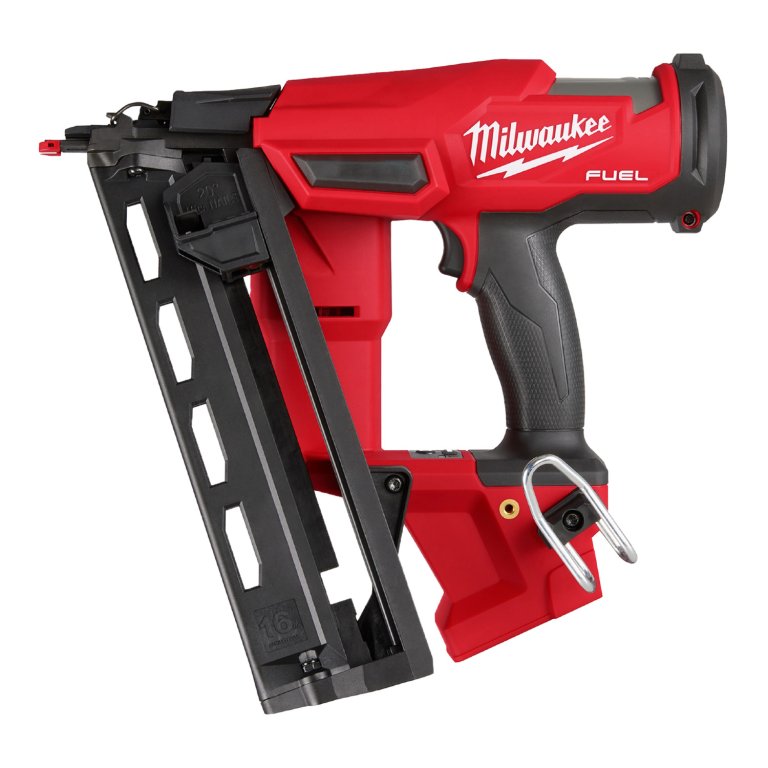
Milwaukee M18 FUEL 16-Gauge Angled Finish Nailer
Photo: The Home Depot
What We Like
- Narrow body allows for great sightline
- Plenty of firepower
- Professional-grade build quality
What We Don’t Like
- A little on the heavy side
Product Specs
-
Nail size:
16 gauge; 1¼ to 2½ inches long -
Power source:
Battery -
Weight:
6.5 pounds
Our Ratings
| Ease of Use | 4.6/5 | Ergonomics | 4.5/5 | Performance | 5/5 | Durability | 5/5 | Value | 4.7/5 |
Milwaukee’s M18 FUEL cordless 16-gauge finish nailer is designed for those who make a living installing trim and cabinetry. It performed flawlessly during testing. We drove 100 nails into both hardwoods and softwoods and experienced no jamming, and the nailer left no nailheads jutting out of the wood surface. We even had to back off the depth setting to avoid driving nails too deep into a ¾-inch-thick sheet of hardwood plywood.
The M18 also fires quickly. In bump mode, we fired nails as fast as we could move our arms up and down. This is clearly a nailer designed for pros.
Despite all of its firepower, the M18 FUEL exacts minimal tearout on wood, producing the smallest nail holes of any nailer we tested. That translates to less time and effort filling nail holes. Whether using its single-fire mode or bump-fire mode, this nailer was accurate and consistent.
It’s not only powerful, but also very maneuverable. The long, streamlined head provides a clear sightline to the tip, making it more accurate than most. That compact head, coupled with its angled design, makes it ideal for tight corners.
Our only complaints were with its weight and the nailer’s no-mar rubber tip, which had a tendency to come off when firing rapidly on bump mode. At 6.5 pounds, the Milwaukee M18 FUEL is also a little heavier than other cordless nailers we tested.
Get the Milwaukee M18 FUEL finish nailer at The Home Depot.
Best Siding Nailer

Photo: Amazon
What We Like
- Fires quickly and accurately
- Lightweight design
- Holds a lot of nails
- Accepts a broad range of nail sizes
What We Don’t Like
- Must switch out trigger to toggle firing modes
Product Specs
-
Nail size:
1¼ to 2¼ inches long -
Power source:
Pneumatic -
Weight:
5.1 pounds
Our Ratings
| Ease of Use | 4.3/5 | Ergonomics | 4.5/5 | Performance | 4.5/5 | Durability | 5/5 | Value | 4.5/5 |
Bostich’s pneumatic siding nailer delivers the performance we’ve come to expect from this brand’s nailers. We put this siding nail gun to the test against some of the tougher siding materials out there, including cedar shake siding and cement siding. It buried some 50 nails in both consistently without leaving heads standing proud. We also didn’t experience any jams, even when firing as fast as we could go.
The Bostich is also one of the easier siding nailers to wield, which is what you want out of a nailer you’ll be operating from a ladder. It only weighs about 5 pounds, and it has a compact size that not only makes it easier to hold but also offers a better line of sight for more accurate nailing. With a capacity of up to 350 nails, it’ll cover a lot of ground before you’ll need to stop for a reload.
While we love the Bostitch siding nailer’s performance, we found the depth adjuster to be a little hard to work, though it does allow for precise changes. After dialing it up for driving nails into cedar, we were able to back down the power to secure vinyl without busting through the tabs. The Bostitch does offer sequential firing, though it requires a trigger change to make that switch.
Get the Bostitch N66C-1 siding nailer at Amazon, Walmart, or Acme Tools.
Best Roofing Nailer
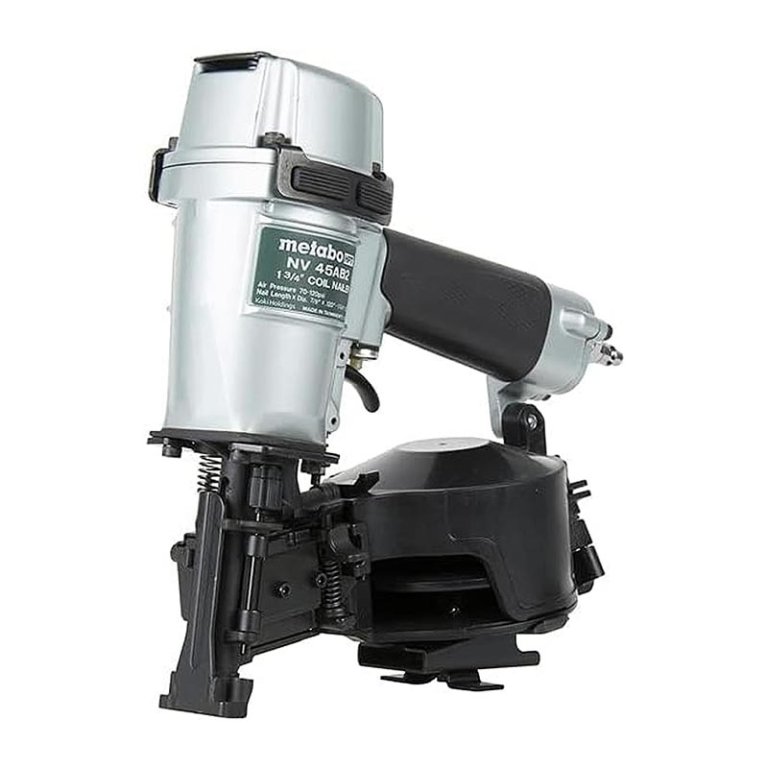
Photo: Amazon
What We Like
- Lightweight for easier rooftop carrying
- Shoots nails accurately for quick shingle installation
- Depth adjustment prevents proud or overdriven nails
- Rubber bumpers prevent tool from sliding off roof
What We Don’t Like
- No tool-belt hook
Product Specs
-
Nail size:
11 gauge; ⅞ to 1¾ inches long -
Power source:
Pneumatic -
Weight:
5.7 pounds
Our Ratings
| Ease of Use | 4.3/5 | Ergonomics | 5/5 | Performance | 4.5/5 | Durability | 5/5 | Value | 4.8/5 |
If there’s one place no one wants to have to refill nail strips frequently, it’s on a roof. That’s why coil roofing nailers are so popular with professional roofers, and the Metabo HPT 1¾-Inch Coil Roofing Nailer was just as good as any we’ve ever used. It shoots standard 11-gauge roofing nails from ⅞ to 1¾ inches long. We loaded a coil of 1¾-inch nails and connected the nailer to our portable air compressor via a hose. Then we started testing.
We used this pneumatic nail gun to attach asphalt shingles to a shed roof. At first, the nailheads were slightly too high, so we adjusted the tool’s depth adjustment until they were flush with the shingles. We tested the Metabo in both single-fire mode and bump mode and found that it shot quickly and powerfully. At one point, we must have hit a nail in the sheathing beneath the shingle, and the gun jammed. Clearing away the jam was simple, though. We just opened the nose of the nail feeder and used a small rod and a hammer to tap it out.
One feature some may overlook, but we appreciated, was the rubber bumpers on the sides of the tool. This is great for those times the roofer has to lay the gun down on the roof while positioning a new strip of shingles—the rubber helps keep the tool from sliding off. (This feature would be particularly helpful on this tool, as it doesn’t have a belt hook.) We also liked the rubber-coated grip that allowed us to get a firm grasp when using the tool. The Metabo is a sound roofing nailer, and we shot more than 150 nails during our test. Plus, it weighs just about 5½ pounds, making it easy to take up on a roof.
Get the Metabo HPT roofing nailer at Amazon, Lowe’s, or Menards.
Best Framing Nailer

Milwaukee M18 FUEL 21-Degree Framing Nailer Kit
Photo: The Home Depot
What We Like
- Fires 3½-inch nails, longer than most competitors
- Angled nail rail for better maneuverability
- Rapid bump mode speeds many tasks
- Good nail-depth adjustment adapts to various wood densities
What We Don’t Like
- Doesn’t have a quick-clear jam release
- Pricey
Product Specs
-
Nail size:
9 to 12 gauge, 2 to 3½ inches long -
Power source:
Battery -
Weight:
11 pounds
Our Ratings
| Ease of Use | 4.8/5 | Ergonomics | 4.5/5 | Performance | 4.6/5 | Durability | 5/5 | Value | 4.5/5 |
When it comes to shooting framing nails accurately, the Milwaukee M18 FUEL 21-Degree Framing Nailer Kit is a top performer. After fully charging the battery, we loaded a strip of 2-inch framing nails and started testing by shooting the nails through ⅝-inch plywood stacked on 2×4 pine boards.
This framing nailer shot the nails powerfully into the wood—a little too powerfully (the heads were sinking), so we adjusted the depth gauge and were able to shoot the nails so that the heads were flush with our plywood. We ran more than a hundred 2-inch nails through the gun and then tested 3-inch framing nails on stacked 2x4s. We switched the gun into bump mode and shot the nails at a rapid pace. This Milwaukee model is powerful. We didn’t experience any problems with nails not sinking as far as we wanted. The 21-degree angle of the nail rail also made the tool more compact and easy to use when nailing between 16-inch wall studs, a standard spacing for both studs and joists.
It would have been nice to have a quick jam release, but a lot of framing nailers don’t include those, so when we had a jam in bump mode, we just removed the nail strip, used the on-tool wrench to open the front panel, and then pulled the jammed nail out with needle-nose pliers.
Get the Milwaukee nail gun at The Home Depot, Acme Tools, or Northern Tool + Equipment.
Jump to Our Review
How We Tested the Best Nail Guns
| Products tested | 10 |
| Time spent testing | 12 hours |
| Tests performed | 3 |
| Price range | $250 to $500 |
Before testing the top nail guns on the market today, we researched over three dozen types and models to see how well users liked their performance. We considered some of the best-regarded brands for this type of tool, including DeWalt, Milwaukee, Metabo, and Bostitch. We also included up-and-comers such as Ridgid and Ryobi, both brands made and sold by The Home Depot.
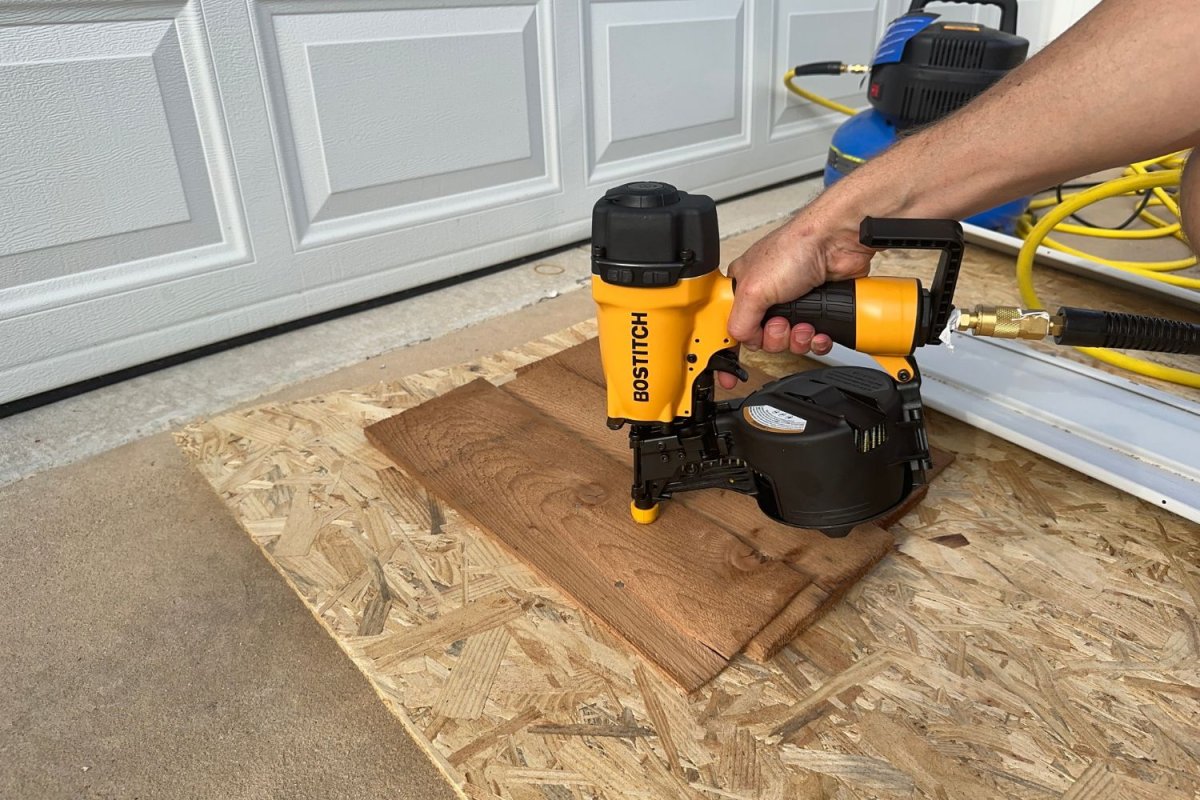
For testing, we loaded the guns with nails of the appropriate sizes and used them to insert fasteners that matched their intended uses. For brad and finish nailers, we shot nails into hardwoods and pine. When testing framing nailers, we shot nails into pine boards and through sheet materials like plywood and OSB. We tested roofing nailers on shingles and the flooring nailer on real hardwood flooring strips. We fired more than 1,500 nails during our comprehensive hands-on testing.
We awarded points for each test using a rubric. The better the tool did, the higher the score it received. After the testing, we averaged each tool’s score and used those numbers to create the corresponding awards.
Our Testing Scores
| Product | Ease of Use | Ergonomics | Performance | Durability | Value |
| DeWalt 20V MAX 16 GA Angled Finish Nailer Kit | 4.8/5 | 4/5 | 4.8/5 | 4.5/5 | 4.5/5 |
| Metabo HPT MultiVolt 16-Gauge 2½-in Finish Nailer | 4.6/5 | 5/5 | 4.3/5 | 4.5/5 | 4.3/5 |
| Ryobi ONE+ HP 18V 16-Gauge Finish Nailer | 4.5/5 | 4/5 | 4.3/5 | 4/5 | 4.5/5 |
| Bostitch Smart Point 18 GA Brad Nailer Kit and Nails | 4.5/5 | 5/5 | 4.3/5 | 4/5 | 4.7/5 |
| Ryobi ONE+ 18V Cordless AirStrike Brad Nailer | 4.4/5 | 4.5/5 | 4.3/5 | 4.5/5 | 4.7/5 |
| Bostitch 2-in-1 Flooring Tool | 4.7/5 | 4.5/5 | 4.8/5 | 4.5/5 | 4.7/5 |
| Milwaukee M18 FUEL 16-Gauge Angled Finish Nailer | 4.6/5 | 4.5/5 | 5/5 | 5/5 | 4.7/5 |
| Bostitch N66C-1 1¼-to-2½-Inch Coil Siding Nailer | 4.3/5 | 4.5/5 | 4.5/5 | 5/5 | 4.5/5 |
| Metabo HPT 1¾-Inch Coil Roofing Nailer | 4.3/5 | 5/5 | 5/5 | 4.8/5 | |
| Milwaukee M18 FUEL 21-Degree Framing Nailer Kit | 4.8/5 | 4.5/5 | 4.6/5 | 5/5 | 4.5/5 |
What to Consider When Choosing the Best Nail Gun
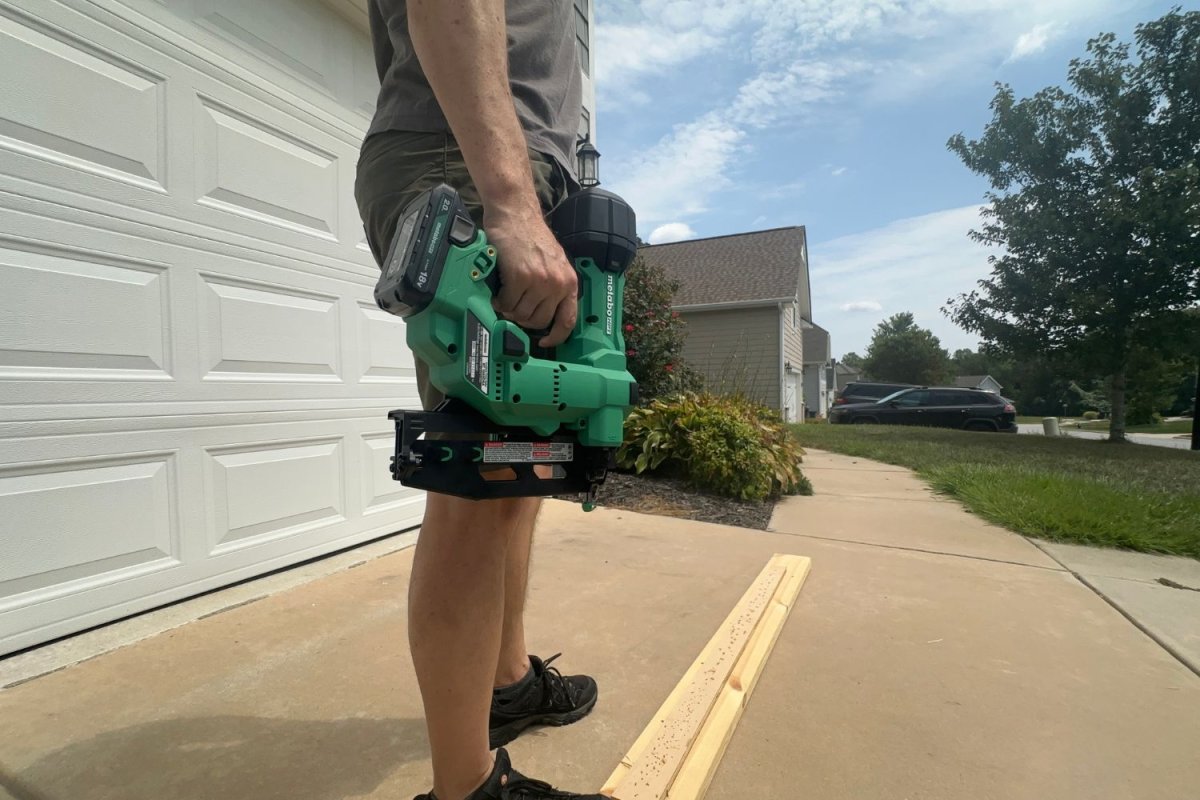
In addition to the size of nails that a nail gun accommodates, consider the type of nail gun, whether a battery or an air compressor powers the nail gun, how many nails the gun will hold, and whether it’s designed to shoot one nail at a time or allows the user to shoot nails rapidly. Accuracy is also important—no one wants to spend valuable time pulling nails that didn’t shoot correctly.
Types of Nail Guns
The expression “the right tool for the job” has never been truer than with nail guns. Select one based on the task(s) and type of nailing project from this list of the most common types of nail guns.
- Framing nail guns are the go-to for putting up a wood structure quickly and securely. A framing nailer offers the power and precision to hold everything in place for decades to come.
- Finish nail guns are designed for installing trim, like baseboards, doorways, and chair rails. They can handle tougher projects, too, like securing a standard floorboard to the drywall behind it.
- Brad nail guns, which fire nails that are slightly smaller in diameter, called brads, are best for delicate trim and custom woodworking projects in which a larger nail might ruin the wood.
- Flooring nail guns, also called “cleat nailers,” secure floor planks to the subfloor below. They speed up the flooring installation process and ensure that each nail is inserted at the correct angle.
- Roofing nail guns are made to drive nails into roofing materials such as tar paper, asphalt, and shingles. They often come with cylindrical cases that hold coils of nails.
- Palm nail guns are lightweight nailers that fit in the palm of the hand to drive nails in tight corners and tricky angles on woodworking projects. While not practical for framing or large-scale projects, they come in handy in close quarters.
- Pin nail guns are the same thing as brad nailers. They shoot small brads and are best suited to detailed trim work. Much of the time, they’re simply called “pinners.”
Power Source
Nail guns are powered by either batteries or by air compressors. Nail guns without a compressor are powered by a battery, so they’re cordless, pricier, and can deliver anywhere from 400 to 1,600 shots per charge. Because they’re not tethered to a cord, battery-powered nail guns can be used anywhere, but they can weigh a hefty 7 pounds or more.
Pneumatic nail guns are powered by air compressors, so they can continue shooting for as long as they’re plugged in and loaded with nails or brads. They weigh 2 to 5 pounds on average and are generally less expensive than, or comparable to, battery-powered nailers. Thanks to their light weight, easy handling, and long runtime, pneumatic nailers remain a popular choice.
Coil vs. Strip Nailer
Nail guns are classified as either coil nailers or strip nailers (also known as stick nailers), terms that refer to how nails are housed inside the tool. Because coil nailers hold nails in a tight coil, they offer a larger capacity—up to 3,000 nails or more in a single coil. Stick or strip nailers hold nails in a straight line, so they hold fewer nails, typically less than 100, depending on the size of the nails.
Firing Mechanism
Nail guns all come with a single-deploy firing mechanism, but some also offer a rapid-deploy mode. In single mode, the user presses the tip of the nail gun firmly to the material and then squeezes the trigger to fire a nail. It’s a two-movement method: press, then squeeze.
In rapid-deploy mode (also called bump mode), the user holds the trigger down and then pushes the gun’s tip to the material, which triggers a shot. This is the fastest way to shoot nails because the user doesn’t have to pull the trigger each time. Almost all framing, roofing, and siding nailers have bump modes, and some finish guns (but not all) have them as well.
Nail Capacity
Nail capacity indicates the range of nail sizes the nailer will shoot. Nail guns are made to hold specific nail gauges, meaning nail thickness. For example, the nail gun might shoot 16-gauge nails (a standard finish nail size), but it will also shoot different lengths of 16-gauge nails. The range of nail lengths will be listed in inches, such as 1¼-inch to 2-inch.
When it comes to nail guns for framing, the nails they accept can vary in thickness and length. Instead of using a gauge measurement, the gun will specify the actual nail thickness range, such as 0.113 inches to 0.148 inches. The nail length range will also appear, such as 2 inches to 3¼ inches.
Nail-Depth Adjustment
Early nail guns didn’t come with the ability to adjust the depth of the nail, but most of today’s models offer that feature, and it’s pretty handy. When installing trim, carpenters countersink the nails so the heads are just below the surface of the wood. This allows them to go back and fill the nail holes with putty to create a smooth, flat surface.
Nail-depth adjustments are just as necessary on framing nail guns where the nail heads should sit flush with the material when installing sheet materials such as plywood sheathing or subflooring. Roofing nailers, which are primarily pneumatic, don’t usually offer nail-depth adjustment, but the roofer can adjust the air pressure on the compressor to adjust the nail depth.
Angled Nail Rail
Some nail guns are listed as being “angled.” This just means the rail that holds the nail strips slants upward—toward the tool’s base. Most angled rails slope around 20 or 21 degrees, although some slope up to 34 degrees. They also require nail strips that correspond to the angle. For example, a 21-degree nail gun will only accommodate 21-degree nail strips.
This does not affect the angle at which the user shoots the nail, however. That’s controlled by the gun’s position when shooting. That said, an angled rail is handier in some nailing situations because the angle makes the tool more compact and easier to maneuver in tight spots.
FAQs
Those buying their first nail gun may have a few additional questions about nail guns in general.
A 16-gauge finish nail gun or an 18-gauge brad nailer is best for installing baseboards.
Use single-fire mode when you need high precision. Use multifire (bump) mode when speed is of the essence.
Yes, nail guns are safe when used responsibly. Like all power tools, nail guns present a risk of injury if used unsafely. Read and follow all safety instructions before using a nail gun.
Yes, you can find corded nail guns, though they are rare. Manufacturers have been making fewer and fewer. You’ll find more options with pneumatic and cordless nail guns.
Yes, though the maintenance they require isn’t too intensive. Nailers should be cleaned and lubricated, and for pneumatic guns, the compressor should be drained. Wiping gunk off the gun to prevent corrosion can help prolong its life, and you should pay close attention to the components and troubleshoot if you notice any kind of damage.
This depends entirely on the type of projects you’ll be tackling. If you plan on using your nail gun for more heavy-duty tasks, like framing or subflooring, a lower-gauge gun would be more appropriate, whereas higher-gauge guns may be better suited for lighter-duty work, like trim and molding projects.
Yes, if the alternative is paying someone else to do whatever project you’ve got in mind, buying a nail gun and doing it yourself can certainly be worth it. For frequent tinkerers, the answer is probably yes, it’s worth it. But if you don’t see yourself frequently working on projects that require a nail gun, you might not need to invest in one.
Meet the Testers
Tony Carrick is a freelance writer specializing in home improvement, landscaping, technology, home security, and design. Carrick has conducted rigorous product testing on everything from power tools to home security systems to backyard grills. With each review, his goal is to help readers determine whether a product meets their needs and if it is or isn’t worth its price tag.
Glenda Taylor is a contractor, product tester, and writer focusing primarily on construction and power tools. She tests a wide range of power tools as well as other home improvement, household, and lawn-and-garden products.
Additional research provided by Amy Lynch.
The post We Fired Over 1,000 Nails to Find the 10 Best Nailers appeared first on Bob Vila.